
Data & Telephone Ducting in Dover
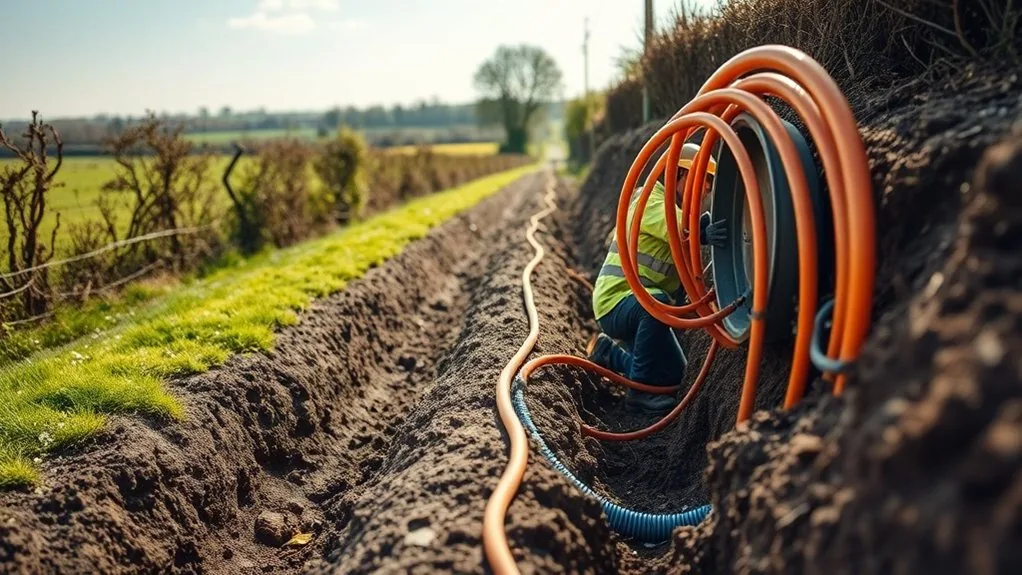
Struggling with unreliable broadband or phone connections due to poor cabling routes? Using data and telephone ducting in Dover ensures your cables are protected, organised and compliant with standards.
This makes future upgrades and repairs easier. Call now for a fast quote or emergency callout in Dover.
Although it’s often hidden from view, data and telephone ducting is the structured network of protective conduits that carries low-voltage communication cables—such as Cat5e, Cat6, fibre optic, and voice lines—between key points within and between buildings. You’re effectively creating a controlled pathway that segregates comms circuits from power, moisture, and mechanical impact.
You use ducting to maintain bend-radius compliance, protect cable insulation, and preserve manufacturer performance specifications. By standardising routes, you also simplify future upgrades, fault-finding, and capacity planning. Correctly specified duct materials and diameters help mitigate signal interference by enabling proper separation, earthing, and, where necessary, additional screening. In practice, ducting is the physical backbone that lets your broadband, telephony, and internal data networks operate reliably and at designed speeds.
Whether you’re planning new infrastructure or remediating legacy cabling, you need data and telephone ducting whenever low-voltage comms circuits must be routed safely, predictably, and to standard. You’ll typically specify dedicated ductwork when you’re coordinating with other underground utilities, segregating power and data, and future‑proofing for bandwidth upgrades that wireless alternatives can’t reliably deliver.
You should consider ducting essential when:
You’ll follow a structured workflow that starts with an initial site assessment to confirm existing utilities, access constraints, and compliance requirements. From there, you’ll agree a detailed route layout, then proceed to controlled trenching and duct installation using appropriate depths, bedding, and segregation for power and data. Finally, you’ll carry out end‑to‑end testing and commissioning to validate continuity, attenuation, and performance before putting the ducting into service.
Before any trench is cut or a single duct is laid, a structured initial site assessment defines what’s technically feasible and compliant for your Dover property. Engineers review existing utilities using statutory records, CAT and Genny scans, and, where required, trial holes, ensuring site safety from the outset. They evaluate ground composition, access constraints, and proximity to buildings, roadways, and boundary lines.
You’ll have your current and future bandwidth requirements profiled, so duct capacity, segregation, and resilience levels can be engineered correctly. Surveyors also assess drainage patterns, flood risk, and potential environmental impact, particularly near trees, waterways, or protected habitats. Compliance with UK regulations, local authority standards, and Openreach/BT specifications is checked, so your ducting infrastructure’s technically robust, auditable, and installation‑ready.
With the site constraints and service requirements defined, attention turns to plotting an efficient, compliant duct route across your Dover property. You’ll move into detailed route planning, mapping proposed duct paths against existing utilities, structural foundations, and access points for ONT, PBX, or comms cabinets.
You’ll evaluate layout configuration options to minimise total duct length, avoid sharp bends, and maintain manufacturer‑specified bend radii. Critical factors include segregation distances from power, depth zoning for future services, and allowance for spare capacity or redundant paths. You’ll also validate entry points through walls or risers, ensuring straight, pull-friendly runs to termination locations. Finally, you’ll document the agreed layout on scaled drawings, forming the reference standard for all subsequent installation activities.
Once the route layout’s locked in, trenching and duct installation translates the design into a controlled, sequenced site operation, starting with accurate setting‑out of trench lines and depth zones across your Dover property. You’ll see excavation follow pre‑agreed alignments, maintaining specified cover, separation from existing utilities, and compliant sidewall support.
Engineers then place bedding material, install appropriately sized ducts, and position draw ropes and access points at defined intervals. Duct grades, bends, and entry angles are controlled to protect future fiber optics and copper pairs, optimising long‑term cable management. Marker tape, warning mesh, and as‑built records are incorporated as standard.
Backfilling uses compacted layers to restore ground integrity, prevent duct deformation, and preserve alignment for future network upgrades.
Although the ducts are now buried and reinstated, the system only becomes operational after structured testing and commissioning verifies every route is clear, continuous, and build‑compliant. You’ll see defined testing procedures applied in sequence: mandrelling to confirm duct integrity, air‑pressure testing for leakage, and CCTV or tracer‑wire verification of alignment and depth.
Next, fibre or copper draw‑ropes are pulled and tension‑tested to validate pull‑paths. As‑built data is reconciled against design to confirm compliance with Openreach, BT, or alternate network commissioning standards. Any non‑conformances are logged, rectified, and re‑tested.
Finally, test certificates, red‑line drawings, and photographic evidence are compiled into a handover pack, so you’ve got verifiable proof the duct network’s ready for cable installation and future upgrades.
In evaluating data and telephone ducting against traditional open-cut excavation, the core distinction lies in methodology, installation efficiency, and long-term network performance. With ducting, you deploy pre-formed conduit routes designed for fiber optics and copper, maintaining consistent bend radii, segregation from power, and predictable attenuation profiles.
Traditional excavation relies on ad‑hoc trenching, direct burial, and variable depths, increasing exposure to mechanical damage, water ingress, and signal interference. Ducting lets you future‑proof corridors for cable replacement or the addition of wireless solutions backhaul without repeat civils. You’re working with controlled entry points, draw ropes, and access chambers, enabling targeted interventions rather than disruptive, linear digs. This structured approach improves as‑built accuracy, eases fault localisation, and standardises your network’s physical layer.
By selecting dedicated data and telephone ducting, you’re not just changing how cables are buried; you’re upgrading the network’s entire physical layer for predictable performance, easier maintenance, and lower lifecycle cost. You get controlled bend radii, segregated pathways, and simplified fault isolation, all of which stabilise latency and bandwidth.
Across real‑world environments, those security, resilience, and lifecycle gains translate directly into how data and telephone ducting is specified for both homes and business premises. In domestic scenarios, you’re routing Indoor wiring for FTTP, multi‑room TV, VoIP, and structured cabling to fixed outlets. Ducts allow you to segregate low‑voltage data from mains, maintain bend‑radius compliance, and future‑proof for bandwidth upgrades or Wireless alternatives such as upgraded access points.
In commercial properties, you’re dealing with higher port densities, riser management, and horizontal distribution from comms rooms to work areas. Ducting supports PoE topologies, IP telephony, security systems, and building‑management networks, while enforcing cable containment standards, minimising crosstalk, and simplifying MACs (moves, adds, changes) as your occupancy, layout, and technology stack evolve.
Whether you’re upgrading a single FTTP feed or delivering a full multi‑tenant backbone, our data and telephone ducting service covers survey, design, installation, and testing for sites throughout Dover. You get a fully engineered pathway solution, aligned with current Openreach, utility, and local‑authority requirements.
We start with on‑site surveys, verifying existing routes, depth, congestion, and clash risks with other utilities. From there, we design duct routes that optimise network topology, minimise bend radius breaches, and future‑proof capacity for fiber optics and copper.
Installation’s managed end‑to‑end: trenching, moling, draw‑rope installation, chambers, and mandrel testing. We then validate continuity and usable capacity, ensuring ducts are pull‑ready for fiber optics, Ethernet, or telephony cabling across business parks, residential developments, and critical infrastructure locations in Dover.
Although many contractors can install basic duct runs, you gain a specialist partner with deep telecoms civils experience, Openreach‑aligned practices, and full CDM‑compliant delivery. You’re working with a team that understands PIA constraints, jointbox scheduling, and wayleave dependencies, so your scheme’s delivered correctly first time.
You benefit from engineered designs that optimise bend radii, spare capacity, and future‑proofing, with detailed Cost considerations at feasibility stage. We’ll rationalise trench routes, consolidate reinstatement types, and minimise night‑works so you control both capex and lifecycle opex.
Methodologies follow HAUC/Chapter 8, NJUG, and Streetworks requirements, while we actively mitigate Environmental impact via reduced dig spans, selective vacuum excavation, and recycled backfill aggregates, achieving robust, compliant duct networks across Dover.
You’ll naturally want clarity on project duration, cost-efficiency versus open-cut trenching, and our geographic coverage across Dover. Below, we address how long typical data and telephone duct installations take under standard site conditions, and whether trenchless ducting provides a more economical solution than traditional excavation. We’ll also specify the Dover postcodes and service areas we can support within our current deployment footprint.
While simple home runs can be completed in hours, the duration of a Data & Telephone Ducting project in Dover depends on route length, ground conditions, existing services, wayleave/permits, and the level of reinstatement required. For a straightforward domestic trench with short runs and minimal cable management, you’re typically looking at 1–2 days onsite, including testing.
More complex commercial installations, especially those requiring segregation from power to reduce signal interference, can extend to 3–7 days. Factor in time for utility searches, CAT scanning, and trial holes to avoid damaging existing plant.
If you’re crossing highways, watercourses, or third‑party land, allow additional lead time for permissions and traffic management, even though the physical duct installation window may still be relatively short.
In cost‑planning terms, “ducting versus digging” is the wrong comparison; the real question is whether installing permanent Data & Telephone Ducting is cheaper than repeated open‑cut excavations and ad‑hoc cable runs over the life of the asset. When you run a proper cost comparison, you’re looking at whole‑life cost, not just day‑one trenching rates.
With ducting, you incur a single civils intervention, then treat the route as reusable infrastructure. You can pull, swap or upgrade fibre and copper without fresh excavation, traffic management, or reinstatement costs. High‑spec uPVC or HDPE duct has predictable material durability and low failure rates, so you reduce fault‑repair spend and service downtime.
Over a typical lifecycle, that capex‑heavy duct solution usually outperforms repetitive digging on total cost of ownership.
Wondering whether our Data & Telephone Ducting teams actually reach your postcode in Dover? You’re covered across all primary urban centres, suburbs, and most rural corridors, subject to route survey and network feasibility. We operate a mapped service matrix aligned with existing comms infrastructure, highway access, and wayleave viability.
To confirm coverage, we cross‑reference your address with Openreach exchanges, fibre backbones, and street‑works constraints, then validate against local regulations and permit windows. This guarantees compliant trenchless installs, minimal environmental impact, and optimised duct routing.
If you’re near major A‑roads, business parks, new‑build estates, or commercial hubs, deployment’s usually straightforward. Outlying farms or hamlets may require bespoke design, including extended duct runs, joint boxes, or micro‑trenching solutions.
Yes, we handle wayleave permissions and council permits for ducting works in Dover. We manage the feasibility assessment, property easements review, and local authority planning permissions. We also coordinate with freeholders, utilities, highways, and inspectors, and prepare necessary documentation such as as-built drawings and traffic management plans.
Yes, existing damaged ducts can often be reused or relined instead of fully replaced. This is possible only after a thorough duct inspection to check structural integrity, clearance, and bend radius. If the ducts are too deformed or collapsed, a full replacement will be necessary following NRSWA-compliant excavation and reinstatement procedures.
We provide written warranty coverage on installed ducts and cabling, depending on manufacturer specifications and proper installation. Our policies include checks for workmanship, joint integrity, and termination quality, confirmed by OTDR and continuity tests. Exclusions apply for damage caused by third parties, overpull, and incorrect backfilling, with all details recorded in an as-built pack containing test certificates, layout drawings, and maintenance advice.
Yes, your ducting materials meet Openreach and other major network providers’ standards. They are manufactured to BT LN-series specifications and comply with BS EN performance classes and CPR-rated polymers. The ducts have calibrated ID/OD tolerances, crush resistance, low-friction inners, and colour/stripe coding that align with mainstream network provider requirements.
Yes, we can coordinate with your internet service provider to schedule activation after duct installation. We will gather your provider’s lead times and arrange necessary surveys, wayleaves (if needed), and activation slots. You will receive a documented timeline with the confirmed activation date, change-control process, and escalation procedures to address any delays.
Ready to scope your next network build or upgrade? Use our structured quotation process to define duct routes, capacity requirements, and interface points with existing infrastructure. You’ll provide site drawings, expected bandwidth, and end-device density so we can dimension duct sizing, jointing chambers, and segregation from LV/HV utilities.
We’ll factor in Weather considerations for Dover’s ground conditions, specifying correct burial depths, drainage, and frost protection. Material options include uPVC, HDPE, and LSZH-rated conduits, selected against load ratings, bend radius, and future-proofing criteria.
Your quote will break down trenching, duct installation, pull-rope provision, draw-pit construction, reinstatement, and optional fibre or copper pulls. Submit your project details online or by CAD/PDF upload and we’ll return a detailed, itemised proposal.